
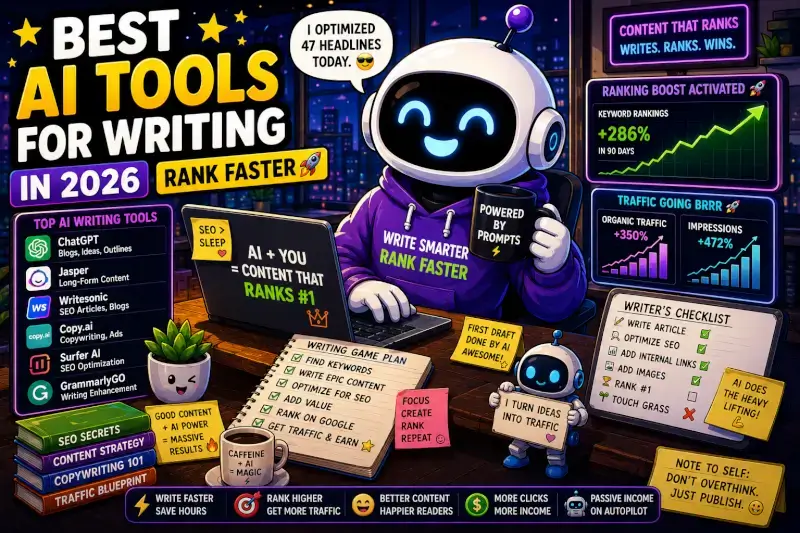
AI writing tools can save bloggers a lot of time.
They can also help you publish a lot of forgettable content very quickly.
That second part gets ignored in most lists of the “best AI writing tools for bloggers.”
The real advantage isn’t getting an AI to produce 2,000 words on command. It’s using AI to remove the slow, repetitive parts of blogging while keeping the research, examples, experience, judgment, and final decisions human.
That might mean using AI to organize research before you write. It could mean finding gaps in a draft, developing a better outline, rewriting a confusing explanation, checking whether you’ve answered the reader’s main question, or turning a finished article into supporting content.
Those are all useful jobs.
Pressing “generate article” and publishing whatever appears is a much weaker workflow.
Best AI Writing Tools for Bloggers at a Glance
| Tool | Best Use | Where It Fits |
|---|---|---|
| ChatGPT | Flexible writing and research assistance | Ideas, research organization, outlines, rewriting, analysis, drafting |
| Jasper | Structured marketing workflows | Brand-controlled content, campaigns, repeatable team workflows |
| Surfer | Content optimization | SEO coverage, content structure, traditional and AI-search optimization |
| Grammarly | Editing and refinement | Clarity, rewriting, communication, final editing |
| Frase | Research-to-content workflows | Briefs, search research, outlines, optimization |
| Writesonic | AI-assisted content production | Drafting, article workflows, search-focused content |
| Rank Math AI | WordPress-centered AI assistance | Content research, writing assistance, optimization, internal linking |
You probably don’t need all of them.
In fact, one of the easiest ways to waste money with AI is to subscribe to several tools that solve nearly the same problem.
What Should Bloggers Actually Use AI For?
A useful blogging workflow separates the jobs AI handles well from the parts that still need your judgment.
Good jobs for AI
- Brainstorming angles and questions
- Organizing notes and research
- Building a first-pass outline
- Finding missing sections or reader questions
- Simplifying complicated explanations
- Creating headline and meta-description variations
- Reformatting information into tables or checklists
- Repurposing a completed article
- Helping edit repetitive or unclear writing
Jobs I wouldn’t hand over blindly
- Deciding which facts are true
- Inventing product experience
- Making unsupported recommendations
- Replacing firsthand testing
- Publishing statistics without checking the source
- Producing dozens of similar pages just to target keywords
Free AI Writing Tools vs. Paid Tools
You don’t need an expensive AI stack to start blogging.
Free access to a general-purpose AI assistant can be enough to test whether AI actually improves your workflow. Specialized paid tools make more sense when you repeatedly hit a specific problem that the free tool doesn’t solve well.
For example, you might eventually want deeper content optimization, a standardized brand voice across a team, or AI assistance directly inside WordPress.
That’s a much better reason to upgrade than subscribing because a tool has a long feature list.
If you’re still learning the basics, see our AI tools for beginners guide before building a complicated stack.
One Thing I have Learned while building TechnofluxAi is that Ai tools usually sound easier to use than they are in the real world. I like to try things myself, see where I get stuck, and figure out what actually saves time instead of just repeating promisies.That’s the approach I use throughout this site: keep what works, point out what doesn’t, and explain things in a way that makes sense for someone who is still learning. I started out searching for an image creator. That was my first interaction with Ai. I was frustrated by the vast tool list without any real direction on which tool was best. Then I realized how powerful this tool was .and was going to be in the future. Making mistakes has helped me in the choice of articles I write.
1. ChatGPT: Best All-Around AI Writing Assistant for Bloggers
ChatGPT is useful for bloggers because writing is only one of the jobs it can handle.
You can give it research notes, files, rough ideas, an unfinished draft, structured data, or a list of questions and ask it to help organize the information.
That makes it useful throughout the workflow instead of only at the “write me a blog post” stage.
Useful blogging tasks
- Brainstorming article angles
- Turning research into an outline
- Finding unanswered questions
- Rewriting awkward paragraphs
- Comparing information
- Creating tables and checklists
- Generating headline variations
- Repurposing finished content
Where bloggers get into trouble
The weak workflow is giving ChatGPT a keyword and asking for a finished article without supplying useful research, examples, experience, or editorial direction.
That often creates content that sounds polished but says roughly the same thing as every other article.
A stronger approach is to give it verified information and use the model as a collaborator rather than an automatic publisher.
If you’re working specifically with ChatGPT, see our ChatGPT prompts for bloggers.
2. Jasper: Best for Structured Marketing and Brand Workflows
Jasper started life with a reputation as an AI copywriting tool, but its current positioning is much broader.
It now focuses heavily on marketing agents, shared brand context, audiences, company knowledge, and repeatable content workflows.
That’s an important distinction.
If you’re one person writing a personal blog, you may not need that level of infrastructure. But if several people create content under the same brand, consistency becomes a real problem.
Jasper makes more sense when:
- Multiple writers work on the same site
- You need consistent brand voice across content
- You create campaigns across several channels
- You want structured, repeatable marketing workflows
- Governance and approvals matter
For a solo blogger who mainly needs brainstorming and drafting help, a general AI assistant may be simpler.
3. Surfer: Best for Optimizing a Finished or Nearly Finished Draft
Surfer isn’t just an AI writer.
Its Content Editor analyzes competing pages and gives you recommendations around topical coverage, structure, terms, and optimization.
It now separates traditional SEO signals from AI-search considerations with SEO Score and AI Search Score alongside its overall Content Score.
Where Surfer fits well
- You already have a useful article
- You want to see what competing pages cover
- You want to identify obvious topical gaps
- You want a structured pre-publish optimization pass
- You care about both traditional search and AI-search visibility
The mistake is treating the score as the article’s actual goal.
If adding another paragraph helps the reader, great. If you’re adding it only to move a score from 76 to 82, think about whether the article is actually improving.
4. Grammarly: Best for Editing and Refining a Draft
Grammarly is no longer just a spell checker.
Its AI tools can help brainstorm, draft, rewrite, refine, and improve communication, while its traditional editing features remain useful for catching awkward wording and obvious mistakes.
I think its most natural place in a blogging workflow is still near the end.
Write the useful article first. Then use editing tools to make it cleaner.
Good uses for bloggers
- Finding clumsy sentences
- Improving clarity
- Rewriting sections that feel awkward
- Checking tone
- Performing a final editing pass
Don’t accept every suggestion automatically. Sometimes a technically cleaner sentence sounds less like you.
5. Frase: Best for Building Search-Focused Content Briefs
Frase is useful when your biggest problem happens before the first draft.
Instead of beginning with a blank document, you can use research and competing content to develop a more informed brief and outline.
That’s particularly useful for bloggers who want a repeatable search-focused process rather than a tool that simply produces paragraphs.
Where Frase fits
- Researching a search topic
- Building article briefs
- Creating informed outlines
- Reviewing content coverage
- Refreshing older articles
The same rule applies here as with other optimization software: competitor coverage is useful evidence, but copying the average structure of the top ten pages isn’t original value.
6. Writesonic: Best for Bloggers Who Want a Dedicated AI Content Platform
Writesonic is closer to the traditional idea of an AI writing platform.
It offers tools aimed at creating and improving longer-form content while increasingly connecting writing with search and AI-search optimization.
That makes it an option for bloggers who prefer a purpose-built content workflow rather than assembling the same process inside a general chatbot.
Consider it when:
- You create long-form content regularly
- You want a more guided article workflow
- You prefer content-specific features over an open-ended chatbot
- You want writing and search workflows closer together
That convenience still doesn’t eliminate editing, source verification, or the need for original input.
7. Rank Math AI: Best for WordPress Bloggers
If you publish with WordPress, Rank Math AI offers a different kind of convenience.
Rank Math now uses Rank Math AI as the umbrella name for its AI-powered capabilities, including Content AI, AI Link Genius, and AI Visibility.
Content AI itself remains part of that system and provides tools for research, writing, rewriting, metadata, FAQs, outlines, and other content tasks.
Where it can fit
- Researching content without leaving the WordPress workflow
- Creating or improving titles and descriptions
- Generating or rewriting sections
- Supporting internal-link workflows
- Keeping optimization close to publishing
If you’re already paying for other AI writing and SEO tools, check the overlap before adding another subscription.
The AI Blogging Workflow I’d Use Instead of “Generate Article”
Define the question, problem, or decision the article actually needs to solve.
Collect primary sources, current facts, examples, screenshots, data, and your own observations.
Use AI to group your notes, identify gaps, suggest questions, and help build a logical outline.
Include your examples, tests, screenshots, experience, reasoning, skepticism, and conclusions.
Use it selectively for difficult explanations, transitions, alternate wording, or sections where it genuinely saves time.
Then use tools such as Surfer, Frase, or Rank Math to look for legitimate gaps.
Remove repetition, generic introductions, unsupported claims, keyword stuffing, and paragraphs that don’t earn their place.
Check names, dates, features, statistics, links, screenshots, prices, and any claim that could have changed.
That process takes more work than generating an article with one prompt.
It also gives you a much better chance of publishing something worth finding.
Which AI Writing Tool Should You Choose?
Instead of comparing twenty feature lists, start with the bottleneck in your own workflow.
If you want one flexible AI tool
Start with ChatGPT.
It can cover brainstorming, organization, research assistance, outlining, rewriting, analysis, and drafting without forcing you into one rigid content workflow.
If you run a content team
Look more closely at Jasper.
Its brand context, marketing agents, and structured workflows make more sense when several people need to produce consistent content.
If your biggest problem is content optimization
Compare Surfer and Frase.
Both are more specialized than a general AI assistant and are useful when search research and content coverage are major parts of your workflow.
If you mainly need editing help
Grammarly may be enough.
You don’t necessarily need another full AI writing platform if your real problem is polishing what you’ve already written.
If you publish heavily in WordPress
Rank Math AI is worth evaluating.
Its advantage is less about replacing every other AI tool and more about keeping useful AI capabilities near the WordPress publishing workflow.
Five AI Writing Mistakes Bloggers Should Avoid
1. Asking AI to Write About Something You Haven’t Researched
An AI-generated paragraph can sound completely confident while missing context or relying on inaccurate information.
Research first. Generate second.
2. Publishing the First Draft
The first output should be raw material, not the final article.
Check every important claim and rewrite the parts that sound generic, repetitive, or unlike you.
3. Removing Yourself From the Article
If AI writes the research, examples, opinions, recommendations, conclusion, and voice, readers are left with very little reason to choose your article instead of asking an AI assistant themselves.
Your perspective is part of the value.
4. Turning Every Keyword Variation Into Another Article
“Best AI writer for bloggers,” “best AI blog writer,” and “best AI tool for writing blogs” may not need three separate URLs.
When the search intent is essentially the same, one strong article is often more useful than several overlapping pages.
5. Confusing More Content With Better Content
AI makes content production easier.
That doesn’t mean your site becomes better every time you press publish.
What About AI Content and Google?
Using AI does not automatically make an article low quality.
The important question is what you’re using it for and what the finished page gives the reader.
If AI helps you research more efficiently, organize information, explain something more clearly, or improve a genuinely useful article, that’s very different from automatically producing large numbers of pages with little original value.
For TechnofluxAI, that means the human contribution should remain obvious: testing, screenshots, examples, workflows, analysis, opinions, limitations, comparisons, or a better explanation than readers can find elsewhere.
Frequently Asked Questions
What is the best AI writing tool for bloggers?
ChatGPT is a strong starting point for many bloggers because it can handle research assistance, brainstorming, outlining, rewriting, analysis, and drafting in one tool.
That doesn’t mean it’s automatically the right choice for every job. Bloggers who need dedicated SEO optimization, team-wide brand control, or WordPress-specific features may prefer a specialized tool.
Can AI write an entire blog post?
Yes, but that doesn’t mean publishing the generated article unchanged is a good idea.
AI can produce a first draft quickly. The finished article still needs accurate research, useful examples, editing, fact checking, and something original that justifies the page’s existence.
Can I use AI writing tools for SEO?
Yes. AI can help organize keyword research, improve structure, identify missing questions, generate metadata options, and assist with content optimization.
Specialized platforms such as Surfer and Frase go further by analyzing search-focused content and optimization signals.
Do I need a paid AI writing tool?
No.
Start with the tools you already have and identify an actual bottleneck first. A paid platform makes more sense when it consistently saves enough time or provides enough useful information to justify the cost.
Should bloggers use AI for every article?
No. AI is a tool, not a publishing requirement.
Sometimes the fastest route is simply writing the paragraph yourself. Use AI where it removes friction or improves the work, not because every stage needs to involve AI.
Can AI replace a blogger?
AI can replace a lot of repetitive blogging tasks.
It cannot supply your real experience, genuine testing, judgment, relationships with readers, original observations, or the credibility that comes from knowing why you’re making a recommendation.
The Bottom Line
The best AI writing tools for bloggers aren’t necessarily the ones that generate the most words.
The useful tools are the ones that remove a genuine bottleneck.
ChatGPT gives you a flexible workspace. Jasper is more focused on structured marketing execution. Surfer and Frase help with search-focused optimization. Grammarly helps refine writing. Writesonic provides a more guided AI-content workflow, and Rank Math AI brings AI assistance closer to WordPress.
You don’t need all of them.
Pick the tool that solves your current problem, learn how to use it well, and keep the parts that actually make your blog different in human hands.
If SEO is the bottleneck you’re trying to solve next, see our AI SEO tools for bloggers guide.

About the Author
Jon Hicks
Founder of TechnofluxAI.
I’m the creator behind TechnofluxAI, focused on breaking down powerful AI tools, emerging trends, and practical strategies to help creators and entrepreneurs stay ahead in a rapidly evolving digital world.
Follow TechnofluxAI for the latest AI tools & strategies